I suppose that I like this commercial because it involves basketball and the main character is named Doug! Doug is a bit like me, particularly when he disgustingly notes "That was a travel" when a dude goes for an under-the-leg slam dunk. And the closing line always makes me smile - "Grab your umbrellas ladies, Hurricane Doug is gonna make it rain."
Saturday, November 30, 2013


Friday, November 29, 2013
SHERMAN'S LAGOON
One of the daily comics that I regularly read is Sherman's Lagoon. Sherman is a down-home, happy-go-lucky Great White Shark, and a regular side-kick is Hawthorne the Hermit Crab. Meet the cast of characters here. Sherman almost always makes me chuckle, but this one made me LOL. Hope you enjoy!

Thursday, November 21, 2013
LEAVING CHURCH

A fellow was stranded on a remote desert island for several decades. A ship happened to spot him and sent a team to the island for the rescue. Of course the man was overjoyed, and as the rescuers looked around, they noted that the fellow had built three huts.
Noting the huts, one man asked, "What's this hut?"
The fellow responded proudly, "That's my house!"
Another man asked, "What's this second hut?"
The fellow again responded enthusiastically, "That's my church!"
Then they asked, "Well, what is the third hut?"
Not so enthusiastically, the fellow answered, "Well, that's the church I used to go to."
h/t to Lee K.
Also, a slightly longer version of this story and some commentary can be found here.
Tuesday, November 12, 2013
JOHN HOWARD YODER
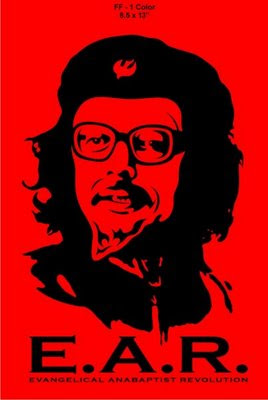
I recently noted this article about JHY in the New York Times. When I was in school, Yoder was on campus at Goshen College because the seminary was still in Goshen. I remember him as usually looking disheveled and seemingly in another world. As the article notes, his scholarship is both embraced and criticized, and continues to be analyzed long after his death, but his behavioral misdeeds make understanding his work and the church's response even more complex. The article link is here.
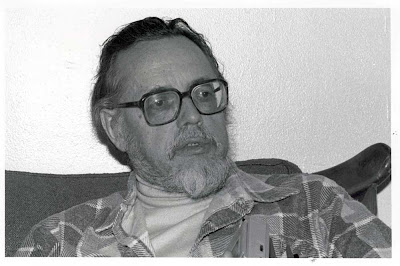
Ms. Heggen had a theory of what Mr. Yoder might have been thinking. “ ‘I
have created this great peace theology,’ ” she began, trying to put his
thoughts into words. “ ‘And you and I are developing a new Christian
theology of sexuality.’ ”
A Theologian’s Influence, and Stained Past, Live On
By MARK OPPENHEIMER
Can a bad person be a good theologian?
All of us fall short of our ideals, of course. But there is a
common-sense expectation that religious professionals should try to
behave as they counsel others to behave. They may not be perfect, but
they should not be louts or jerks.
By that standard, few have failed as egregiously as John Howard Yoder,
America’s most influential pacifist theologian. In his teaching at Notre
Dame and elsewhere, and in books like “The Politics of Jesus,”
published in 1972, Mr. Yoder, a Mennonite Christian, helped thousands
formulate their opposition to violence. Yet, as he admitted before his
death in 1997, he groped many women or pressured them to have physical
contact, although never sexual intercourse.
Mr. Yoder’s scholarly pre-eminence keeps growing, and with it the
ambivalence that Mennonites and other Christians feel toward him. In
August, Ervin Stutzman, executive director of Mennonite Church USA, which has about 100,000 members, announced the formation of a “discernment group” to guide a process to “contribute to healing for victims” of Mr. Yoder’s abuse.
In 1992, after eight women pressured the church to take action, Mr. Yoder’s ministerial credentials were suspended
and he was ordered into church-supervised rehabilitation. It soon
emerged that Mr. Yoder’s 1984 departure from what is now called Anabaptist Mennonite Biblical Seminary,
in Elkhart, Ind., had also been precipitated by allegations against
him. He left for Notre Dame, where administrators were not told what had
happened at his last job.
But Mr. Yoder emerged as a hero of repentance. His accusers never spoke
publicly, and their anonymity made it easier for some to wish away their
allegations. And in December 1997, after about 30 meetings for
supervision and counseling, Mr. Yoder and his wife were welcomed back to
worship at Prairie Street Mennonite Church in Elkhart. To cap a perfect
narrative of redemption, he died at 70 at the end of that month
.
Without denying the wrongness of his acts, his supporters continued to
celebrate Mr. Yoder and the Mennonite leaders who had rehabilitated him.
“How John’s community responded to his inappropriate relations with
women” was “a testimony to a community that has learned over time that
the work of peace is slow, painful, and hard,” wrote Stanley Hauerwas, a retired Duke University professor and Yoder’s heir as the leading pacifist theologian, in his 2010 memoir.
Mr. Yoder’s obituary in The New York Times did
not mention his sexual misdeeds. None of his victims received monetary
settlements. Mr. Yoder apologized, sort of, with a statement that “he
was sorry that we had misunderstood his intentions, as he never meant to
hurt us,” according to Carolyn Holderread Heggen, one of the eight
complainants.
Ted Koontz,
a professor at Mr. Yoder’s old seminary and a member of the church’s
discernment group, said the church needed to take stock of what was — or
was not — done for Mr. Yoder’s victims.
“There are a lot of different opinions about what was done and wasn’t
done to hold him accountable,” Professor Koontz said.
The committee will probably conclude its work, he added, in time for the
Mennonite Church USA’s 2015 convention in Kansas City, Mo., where there
may be a ceremony “of confession, repentance, reconciliation.”
Of course, reconciliation was what the four-year process in the 1990s
was supposed to achieve. It obviously failed. And Mr. Yoder remains
inescapable for Mennonites, his work read and referenced often and
everywhere.
“Physically he died, but his work and his theological writings live on,”
said Linda Gehman Peachey, a freelance writer in Lancaster, Pa., who is
also part of the six-member group. “For those who have known this other
side — his behavior, particularly toward women — that is really
painful.”
Mr. Yoder’s memory also presents a theological quandary. Mennonites tend
to consider behavior more important than belief. For them, to study a
man’s writings while ignoring his life is especially un-Mennonite.
Professor Koontz regularly tells his students reading Mr. Yoder that
“his behavior is one thing we ought to take into account when we read
his work.” Ms. Peachey noted that Mr. Yoder wrote a good deal about
suffering as a Christian virtue, but “if you know this part of the
story” — how he made women suffer — “you tend to read it with a
different eye.”
Mr. Yoder seemed very attentive to the notion that theology should align
with behavior. It turns out that in unpublished papers, he formulated a
bizarre justification of extramarital sexual contact.
In his memoir, Professor Hauerwas alludes to what Tom Price, a reporter for the newspaper The Elkhart Truth, described in a five-part 1992 series
as Mr. Yoder’s defense of “nongenital affective relationships.” Mr.
Yoder said that touching a woman could be an act of “familial” love, in
which a man helped to heal a traumatized “sister.”
Mr. Price quoted from “What Is Adultery of the Heart?” a 1975 essay in
which Mr. Yoder wrote that a “bodily” embrace “can celebrate and
reinforce familial security,” rather than “provoking guilt-producing
erotic reactions.”
Ms. Heggen, called Tina in the newspaper articles, told Mr. Price that
Mr. Yoder had a grandiose explanation for his advances, which he tried
out on multiple women.
“We are on the cutting edge,” Mr. Yoder would say, according to Ms.
Heggen. “We are developing new models for the church. We are part of
this grand, noble experiment. The Christian church will be indebted to
us for years to come.”
On Wednesday, Ms. Heggen, agreeing to be identified as a victim for the
first time, recalled driving Mr. Yoder to the Albuquerque airport in
1982. He asked her to get out for “a proper goodbye,” Ms. Heggen said.
“Then he pulled me into his belly and held me tight for a painfully long
time. I realized I couldn’t escape his clutch.”
In 1992, Ms. Heggen, who now lives in Oregon, published a book about sexual abuse.
Traveling the world, lecturing about her book, she said she met
“significantly” more than 50 women who said that Mr. Yoder had touched
them or made advances.
“Women inevitably come up after these events and tell you their story,”
Ms. Heggen said. “The scenario was so familiar to me, and I would
interrupt them and say, ‘Are you talking about John Howard Yoder?’ They
would say, ‘How did you know?’ ”
After his advance toward her, Mr. Yoder mailed Ms. Heggen an essay in
which he advocated physical contact, including nudity, between unmarried
people, so long as “there wasn’t lust.”
Monday, November 11, 2013
JESUS & MO
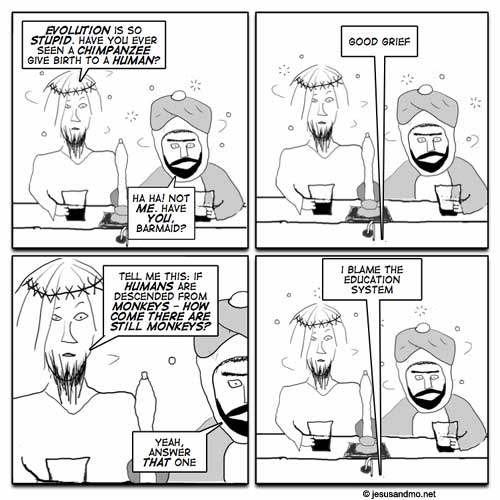
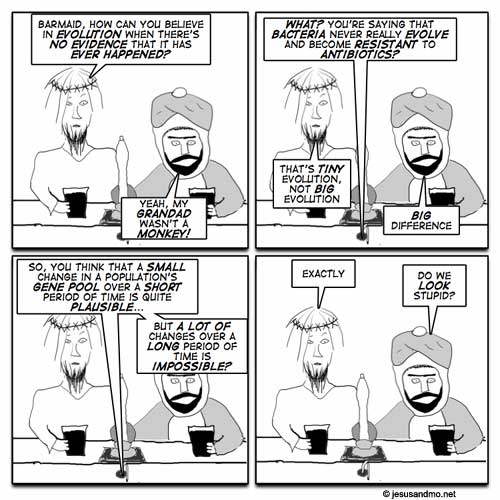
Yeah, I understand that this cartoon can often be beyond edgy, but sometimes cartoonists challenge our beliefs and make us sharpen our thinking about what we consider to be true. Jesus & Mo is certainly irreverent [I believe that the author is anonymous because the series uses images of Mohammed, a real no-no in the Muslim world]. Jesus and Mo chat about many subjects, but I am fond of their conversations regarding evolution, three of which are shown below. If you think you can handle more, visit the website.

Friday, November 08, 2013
YOUNG PLAYS DYLAN

Follow this link to a very interesting account of Neil Young playing Dylan songs across the decades. It is an entry from Johanna's Visions - A Music Site. Hat tip to BIL KenBob. Go to Johanna's website for some very interesting entries, such as Bruce Springsteen Plays Bob Dylan, birthday wishes to folks like Bonnie Raitt and Joni Mitchell, and videos from Dylan concerts.

Johanna's Visions
Subscribe to:
Posts (Atom)