Thursday, December 06, 2012

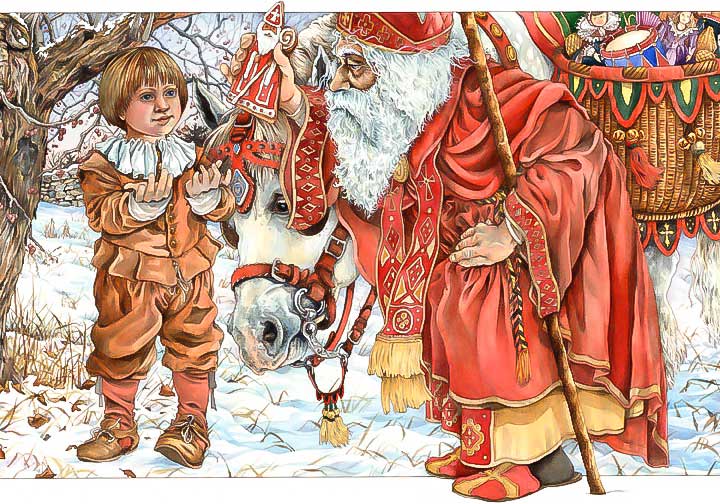
SAINT NICHOLAS DAY

December 6th has long been a special day because it is the birth day of our daughter.  However, I learned that it is also a special day for many folks, particularly in Germany, because it is Saint Nicholas Day.


You can read about Saint Nicholas here and here, but the Saint Nicholas Center website is completely dedicated to Nicholas and Saint Nicholas Day.  Here are a couple of snippets from the site:
 
The true story of Santa Claus begins with Nicholas, who was born during the third century in the village of Patara. At the time the area was Greek and is now on the southern coast of Turkey. His wealthy parents, who raised him to be a devout Christian, died in an epidemic while Nicholas was still young. Obeying Jesus' words to "sell what you own and give the money to the poor," Nicholas used his whole inheritance to assist the needy, the sick, and the suffering. He dedicated his life to serving God and was made Bishop of Myra while still a young man. Bishop Nicholas became known throughout the land for his generosity to the those in need, his love for children, and his concern for sailors and ships.
 
Under the Roman Emperor Diocletian, who ruthlessly persecuted Christians, Bishop Nicholas suffered for his faith, was exiled and imprisoned. The prisons were so full of bishops, priests, and deacons, there was no room for the real criminals—murderers, thieves and robbers. After his release, Nicholas attended the Council of Nicaea in AD 325. He died December 6, AD 343 in Myra and was buried in his cathedral church, where a unique relic, called manna, formed in his grave. This liquid substance, said to have healing powers, fostered the growth of devotion to Nicholas. The anniversary of his death became a day of celebration, St. Nicholas Day, December 6th (December 19 on the Julian Calendar).

In Roman Catholic areas of southern Germany, such as Bavaria, Sankt Nikolaus still comes as a bishop with flowing beard and a bishop's miter and staff. Houses are thoroughly cleaned and children clean and polish their shoes or boots in preparation for the saint's visit. On the evening before St. Nicholas Day, children put letters to the good saint along with carrots or other food for his white horse or donkey on a plate or in their shoes. These are left outside, under the bed, beside a radiator, or on a windowsill in hopes of finding goodies from St. Nicholas the next morning. During the night Sankt Nikolaus goes from house to house carrying a book in which all the children's deeds are written. If they have been good, he fills their plate, shoe or boot with delicious fruits, nuts and candies. If not, they may find potatoes, coal, or twigs.

Wednesday, December 05, 2012

BIG BANG BLOOPERS

If you are not amused by The Big Bang Theory, you may not be amused by these bloopers.  For me - actually laughed out loud a few times.....and there are many more on YouTube.


Monday, December 03, 2012

SCHLOß HEIDELBERG

You can read all about the Heidelberg Castle here and here, and see nice pictures here, but what follows are pictures that I took which means that when you click on them, you will see enlarged versions with nice details.  The Pepperdine house is only a couple of blocks from the castle with an address of Graimbergweg 10, and you can read about Graimberg here.


Saturday, December 01, 2012

FACES OF AMERICAN DEAD IN VIETNAM: ONE WEEK'S TOLL

The following is taken from the Life Magazine website. When I was looking for the Life cover of the Kent State shootings, it brought back vivid memories of this particular issue of Life. I still have a copy in a storage box in the garage. I highly recommend clicking here to visit the website and page through the pictures of 101 of  the 242 military service personnel who died that week.
_______________________________________________________________________

In June 1969, LIFE magazine published a feature that today, incredibly, remains as moving and, in some quarters, as controversial as it was when it sparked debate and intensified a nation’s soul-searching more than 40 years ago. On the cover, a young man’s face — the very model of middle-America’s “boy next door” — along with 11 stark words: “The Faces of the American Dead in Vietnam: One Week’s Toll.” Inside, across 10 funereal pages, LIFE published picture after picture and name after name of 242 young men killed halfway around the world — in the words of the official announcement of their deaths — “in connection with the conflict in Vietnam.”
 
Vietnam, One Week's Dead, LIFE magazine cover, 1969
 
 
Michael C. Volheim, 20, Army, SP4, Hayward, Calif.


LIFE, June 27, 1969


To absolutely no one’s surprise, the public’s response was immediate, and visceral. Some readers expressed amazement, in light of the thousands of American deaths suffered in a war with no end in sight, that it took so long for LIFE to produce something as dramatic and pointed as “One Week’s Toll.” Others were outraged that the magazine was, as one reader saw it, “supporting the antiwar demonstrators who are traitors to this country.” Still others — perhaps the vast majority — were quietly and disconsolately devastated. (See reader’s responses at the bottom of this page.)

Here, four decades after the last American combat troops left Vietnam — and as the United States once again fights a protracted, ambiguous war with a shadowy enemy on the other side of the globe — LIFE.com is republishing every picture and every name that originally appeared in (as the article itself was titled) “One Week’s Dead.”

Below is the text, in full, that not only accompanied portraits of those killed, but also explained why LIFE chose to publish “One Week’s Dead” when — and in the manner — it did.

From the June 27, 1969, issue of LIFE:

The faces shown on the next pages are the faces of American men killed — in the words of the official announcement of their deaths — “in connection with the conflict in Vietnam.” The names, 242, of them, were released on May 28 through June 3 [1969], a span of no special significance except that it includes Memorial Day. The numbers of the dead are average for any seven-day period during this stage of the war.

It is not the intention of this article to speak for the dead. We cannot tell with any precision what they thought of the political currents which drew them across the world. From the letters of some, it is possible to tell they felt strongly that they should be in Vietnam, that they had great sympathy for the Vietnamese people and were appalled at their enormous suffering. Some had voluntarily extended theirs tours of combat duty; some were desperate to come home. Their families provided most of these photographs, and many expressed their own feelings that their sons and husbands died in a necessary cause. Yet in a time when the numbers of Americans killed this war — 36,000 — though far less than the Vietnamese losses, have exceeded the dead in the Korean War, when the nation continues week after week to be numbed by a three-digit statistic which is translated to direct anguish in hundreds of homes all over the country, we must pause to look into the faces. More than we must know how many, we must know who. The faces of one week’s dead,unknown but families and friends, are suddenly recognized by all in this gallery of young American eyes.

Below is the text, in full, from the last page of the “One Week’s Dead” feature in LIFE:

‘I see death coming up the hill’
On the back of a picture he sent home shortly before his death near Saigon, Sgt. William Anderson, 18, of Templeton, Pa., jotted a wry note: “Plain of Reeds, May 12, 1969. Here’s a picture of a 2-star general awarding me my Silver Star. I didn’t do anything. They just had some extra ones.” His family has a few other recent photographs of the boy, including one showing him this past February helping to put a beam into place on his town’s new church. His was the first military funeral held there.
Such fragments on film, in letters, in clippings and in recollection comprise the legacies of virtually every man show in these pages. To study the smallest portion of them, even without reference to their names, is to glimpse the scope of a much broader tragedy. Writing his family just before the time he was scheduled to return to the U.S., a California man said, “I could be standing on the doorstep on the 8th [of June]…As you can see from my shaky printing, the strain of getting ‘short’ is getting to me, so I’ll close now.” The ironies and sad coincidences of time hang everywhere.

One Pfc. from the 101st Airborne was killed on his 21st birthday. A waiting bride had just bought her own wedding ring. A mother got flowers ordered by her son and then learned he had died the day they arrived. A Texan had just signed up for a second two-year tour of duty when he was killed, and his ROTC instructor back home remembered with great affection that the boy, a flag-bearer, had stumbled a lot. In the state of Oregon a solider was buried in a grave shared by the body of his brother, who had died in Vietnam two years earlier. A lieutenant was killed serving the battalion his father had commanded two years ago. A man from Colorado noted in his last letter that the Marines preferred captured North Vietnamese mortars to their own because they were lighter and much more accurate. At four that afternoon he as killed by enemy mortar fire.

Premonitions gripped many of the men. One wrote, “I have given my life as have many others for a cause in which I firmly believe.” Another, writing from Hamburger Hill, said, “You may not be able to read this. I am writing it in a hurry. I see death coming up the hill.” One more, who had come home on leave from Vietnam in January and had told his father he did not want to go back and was considering going AWOL, wrote last month, “Everyone’s dying, they’re all ripped apart. Dad, there’s no one left.” “I wish now I had told him to jump,” the boy’s father recalled. “I wish I had, but I couldn’t.”

Such despair was not everywhere. A lieutenant, a Notre Dame graduate, wrote home in some mild annoyance that he had not been given command of a company. (“I would have jumped at the chance but there are too many Capts. floating around”) and then reported with a certain pleasure that he was looking forward to his new assignment, which was leader of a reconnaissance platoon. In an entirely cheerful letter to his mother a young man from Georgia wrote, “I guess by now you are having some nice weather. Do you have tomatoes in the garden? ‘A’ Co. found an NVA farm two days ago with bananas, tomatoes and corn. This is real good land here. You can see why the North wants it.”

There is a catalogue of fact for every face. One boy had customized his 13-year-old car and planned to buy a ranch. Another man, a combat veteran of the Korean War, leaves seven children. A third had been an organist in his church and wanted to be a singer. One had been sending his pay home to contribute to his brother’s college expenses. The mother of one of the dead, whose son was the third of four to serve in the Army, insists with deep pride, “We are a patriotic family willing to pay that price.” An aunt who had raised her nephew said of him, “He was really and truly a conscientious objector. He told me it was a terrible thought going into the Army and winding up in Vietnam and shooting people who hadn’t done anything to him…such a waste. Such a shame.”

Every photograph, every face carriers its own simple and powerful message. The inscription on one boy’s picture to his girl reads:

To Miss Shirley Nash
We shall let no Love come between Love.
Only peace and happiness from Heaven Above.
Love always.

Perpetually yours,
Joseph


Below are some of the reactions from readers that were published in the August 18, 1969, issue of LIFE — in which the entire Letters section of the magazine was given over to responses to “One Week’s Dead”:

Your story was the most eloquent and meaningful statement on the wastefulness and stupidity of war I have ever read. — From a reader in California

Certainly these tragic young men were far superior to the foreign policy they were called upon to defend. — From a U.S. Marine Corps Captain (resigned)

I feel you are supporting the antiwar demonstrators who are traitors to this country. You are helping them and therefore belong to this group. — From a reader in Texas

I cried for those Southern black soldiers. What did they die for? Tar paper shacks, malnutrition, unemployment and degradation? — From a reader in Ohio

While looking at the photographs I was shocked to see the smiling face of someone I used to know. He was only 19 years old. I guess I never realized that 19-year-olds have to die. — From a reader in Georgia

I felt I was staring into the eyes of the 11 troopers from my platoon who were killed while fighting for a cause they couldn’t understand — From a Marine second lieutenant in New Jersey who had commanded a rifle platoon in Vietnam


Thursday, November 29, 2012

LAWRENCE GUYOT

Guest Commentary by | November 27, 2012

In Memoriam: Lawrence Guyot


Lawrence Guyot
By Alan Bean
I first learned about Lawrence Guyot from reading Taylor Branch’s celebrated Trilogy on the King Years. His name came up again when I researched the background of the Curtis Flowers story.
 
Readers of this blog will know that Guyot, Fannie Lou Hamer and several other civil rights activists were beaten within an inch of their lives by men under the command of Sheriff Earl Wayne Patridge at the Montgomery County Courthouse in Winona, Mississippi in June of 1963. Three decades later, Mr. Flowers was arrested on the basis of fabricated evidence for the 1996 slaying of four people at a Winona furniture store.
 
A little over a year ago, I had the chance to meet the man in the flesh when he spoke at an event in Cleveland, MS sponsored by the Samuel Procter Oral History Program at the University of Florida. The civil rights icon seemed more interested in telling the students what they needed to do in the present moment than he was in sharing tidbits of civil rights nostalgia. This September, my wife Nancy and I shared our story with the Florida students
.
This New York Times story captures the essence of Guyot’s amazing saga. There was nothing unusual about the man. He was not particularly eloquent or brilliant; he just refused to back down in the face of injustice. Without Lawrence Guyot’s brand of anonymous courage, the civil rights movement could not have succeeded.
 

Lawrence Guyot, Civil Rights Activist Who Bore the Fight’s Scars, Dies at 73

By
Published: November 26, 2012
Lawrence Guyot, who in the early 1960s endured savage beatings as a young civil rights worker in Mississippi fighting laws and practices that kept blacks from registering to vote, died Thursday at his home in Mount Rainier, Md. He was 73.
 
His daughter, Julie Guyot-Diangone, confirmed his death, which she said came after Mr. Guyot had suffered several heart attacks, lost a kidney and became diabetic.
 
Mr. Guyot (GHEE-ott) was repeatedly challenged, jailed and beaten as he helped lead fellow members of the Student Nonviolent Coordinating Committee and student volunteers from around the nation in organizing Mississippi blacks to vote. In many of the state’s counties, no blacks were registered
.
He further pressed the campaign for greater black participation in politics by serving as chairman of the integrated Mississippi Freedom Democratic Party, formed to supplant the all-white state Democratic Party. It lost its challenge to the established Mississippi party at the Democratic National Convention in 1964, but its efforts are seen as paving the way for the passage of the Voting Rights Act of 1965.
 
Lawrence Guyot displays the wounds inflicted in a Winona prison cell
 
A famous moment in the civil rights movement occurred after Fannie Lou Hamer and two other civil rights workers were arrested for entering an area of a bus station reserved for whites in Winona, Miss., in June 1963. Mr. Guyot went to Winona to bail them out of jail. When he asked questions about their rough treatment, nine police officers beat him with the butts of guns, made him strip naked and threatened to burn his genitals. The abuse went on for four hours until a doctor advised the officers to stop.
 
Mr. Guyot was taken to a cell and beaten some more. The cell door was left open to the outside, with a knife lying just beyond. The guards’ apparent idea was to entice him to try to escape, but he saw two men lurking outside and stayed in his cell. “I didn’t fall for that one,” he is quoted as saying in “My Soul Is Rested: The Story of the Civil Rights Movement in the Deep South” (1977), by Howell Raines.
 
Mr. Guyot was released after Medgar Evers, another civil rights activist, was assassinated in Jackson, Miss., on June 12. Mr. Guyot thought that the authorities feared the effects of another assassination of a civil rights worker when national attention was focused on Mississippi.
 
Later in 1963, Mr. Guyot was imprisoned at the infamous Mississippi penitentiary Parchman Farm. He was beaten, and went on a 17-day hunger strike. He lost 100 pounds. “It was a question of defiance,” he said in an interview with NPR in 2011. “We were not going to let them have complete control over us.”
 
In a recent interview with The Afro-American Newspapers, Timothy Jenkins, an educator who worked with Mr. Guyot in the 1960s said: “He is significant because he knew there is a price more ultimate than death. It is disgrace.”
 
Lawrence Thomas Guyot Jr. was born in Pass Christian, Miss., on July 17, 1939. His father was a contractor. Mr. Guyot attended Tougaloo College in Tougaloo, Miss., a historically black college that had some white faculty members and welcomed white students. He graduated with a degree in chemistry and biology in 1963.
 
While in college, he became involved with the Student Nonviolent Coordinating Committee and traveled around the state conducting civil rights workshops and doing other organizing. He and his colleagues concentrated on voter registration, not desegregation. When he took someone to the courthouse to register, he was often followed by two cars of whites.
 
Mr. Guyot was haunted by a 1964 conversation he had with Michael Schwerner, the civil rights worker who would be murdered that year along with his fellow workers Andrew Goodman and James Chaney. As Mr. Schwerner was preparing to drive to Mississippi from a training session in Ohio, he asked Mr. Guyot if it was safe to go. Mr. Guyot said yes, and always felt responsible for what happened later.
 
“I told him to go because I thought there was so much publicity that nothing could happen,” Mr. Guyot said in an interview with The Sun Herald of Biloxi, Miss. “I was absolutely wrong.”
 
In 1968, while in Chicago as a delegate to the Democratic convention, Mr. Guyot went to a doctor after falling ill. The doctor told him that he had heart trouble and was overweight, and that if he went back to the civil rights struggle in Mississippi he had perhaps two months to live. Instead he went to Rutgers School of Law and, after graduating in 1971, moved to Washington, where he did legal work for city agencies and was an informal adviser to Mayor Marion Barry, a fellow native Mississippian.
In addition to his daughter, Mr. Guyot is survived by his wife of 47 years, the former Monica Klein; his son, Lawrence III; and four grandchildren.
 
Mr. Guyot favored same-sex marriage when it was illegal everywhere in the United States, noting that he had married a white woman when that was illegal in some states. He often gave inspirational speeches on the meaning of the civil rights movement.
 
“There is nothing like having risked your life with people over something immensely important to you,” he said in 2004. “As Churchill said, there’s nothing more exhilarating than to have been shot at — and missed.”
_____________________________________________________________________________
 
Some of you readers, like me, were teenagers and college students during these times, and thus will remember well the names and events of the civil rights and anti-war movements.  Schwerner, Chaney and Goodman, the Life Magzine cover photo of Kent State, and myriad other images are etched into our minds.