Perspectives of a Colorado Curmudgeon on topics ranging from Basketball to Music to Science & Religion to Travel to Memories, touching on a bit of everything.
I snagged this as soon as I noted that it was a signed print.
TÉU-MAHS KÁTCHINA
JJ MORA
140/650
10" x 14"
Below the TÉU-MAHS KÁTCHINA title, the subtitle reads "Mother of Two - Tuen Whuip Kat's [Hopi] East Mesa 1904 #13
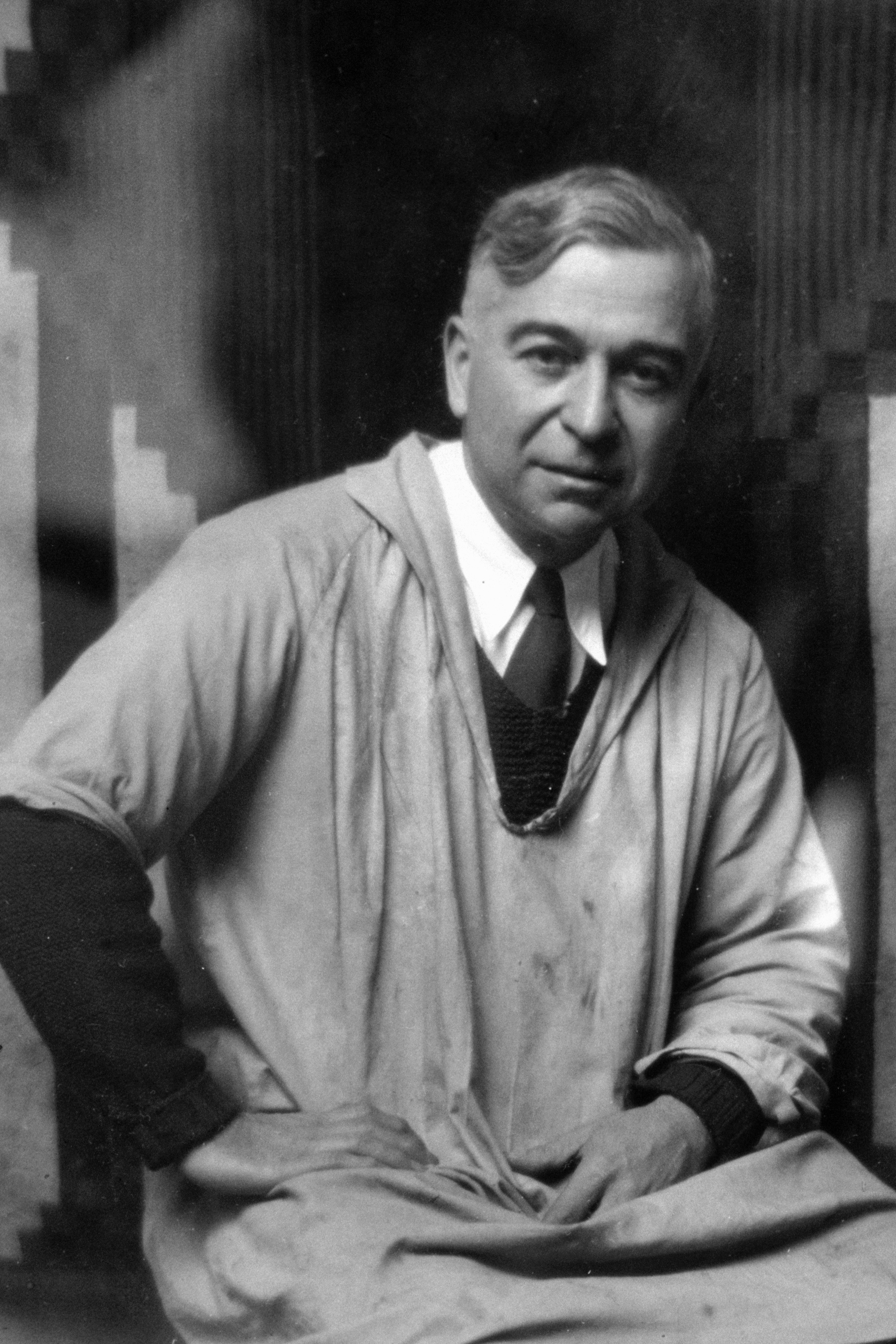
Joseph Jacinto Mora (October 22, 1876 – October 10, 1947) was a Uruguayan-born American cowboy, photographer, artist, cartoonist, illustrator, painter, muralist, sculptor, and historian who wrote about his experiences in California. He has been called the "Renaissance Man of the West". Read more of Mora by clicking the Wikipedia entry.
This particular print is apparently a part of a series of eight, and more detailed information can be found here.
When I spotted this painting resting in a bin, I snagged it immediately because I liked the style, subject matter and composition. A quick google told that the artist is Ben Nelson, aka Ahn Hia Ohm.
Untitled* 4" x 7" Original Watercolor - 1993
*I could not find a title for this watercolor, but other paintings have titles like An Honorable Return, Encounter, and They Return Singing and a possible title for this would be Kiowa Horseback Riders. I have found similar paintings that have sold at auction for several hundred dollars.
Here is the AI Summary of Ben Nelson's Art:
Ben Nelson, also known as Ahn Hia Ohm, meaning He Knows, is a contemporary Native American artist of Kiowa, Navajo, Taos Pueblo,
and Delaware descent, born in 1982. His intricate, self-taught
watercolors are inspired by his Kiowa heritage and often depict scenes
of historical and active Native American life, including dances, hunts,
and horsemen, in a ledger-style format.He
began painting as a child prodigy, winning awards at Indian Market, and
his work has been featured on the cover of Indian Arts magazine.
Read abouthis journey from Ben Nelson to Ahn Hia Ohm to A-The Son of Picasso at this link
Those of you who have spent some of your valuable time reading my ramblings may remember my post about The Goodwill Outlet Stores, otherwise known as The Bins [link here]. One of the more amazing things about the 'last chance' material that gets sent to The Bins is the amount and quality of artwork, some of it quite nice. So this post is going to be the first in a series that describes some of our "finds." We are particularly fond of Western and Southwestern art, so everything that we have picked up fits this genre. And remember, at The Bins, you pay by the pound, with a maximum of $10 for any heavier items.
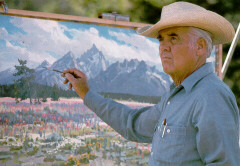
The first piece of art is a print by Conrad Schwiering. The Wikipedia entry on Schwiering can be found here. And this is a photo of the artist and one of his paintings:
1916-1986
Tetons 20" x 24" Lithograph 49/500
This is the print that we found - click on image to enlarge. Schwiering lived for a long time in Jackson, Wyoming, and many of his paintings are of the Tetons. This particular print is Number 49/500 and is numbered and signed by the artist. I found another copy of this print for sale on eBay for $399, but could not find any recent sales of lithographs like this. Too bad it's not an original - those go for $5,000 and up!!!
I am a regular reader of the Comics Section of the Denver Post - I don't follow all of the strips [some seem pretty lame to me], but I am a fan of Mutts, and all of its characters including Guard Dog.
From Patrick McDonnell, the creator of Mutts:
NEW YORK (AP) — Something is different on the comics pages this week. In the panels of “Mutts,” there’s the long-delayed sight of freedom.
Patrick McDonnell, the cartoonist who draws the popular strip, is freeing his character Guard Dog, liberating an animal who has become for decades a symbol of the cruelty of dog chaining.
“I think it just hit me that I can’t do it forever and that it has to happen,” McDonnell told The Associated Press ahead of the publication of Thursday’s panel showing Earl’s owner kneeling beside the dog and announcing: “We have to remove this chain.” On Friday’s strip, it will be gone.
“I had a vague idea what the story was going to be, but I finally took some time and said, ‘Well, what is that story?’ And I was happy with what I came up with. So I said, ‘Now’s the time to do it.’”
“Mutts” premiered in 1995 with two heroes — the small canine Earl and the feline Mooch, fond of saying “Yesh.” There’s also Woolfie, Sid the fish, Crabby, Sourpuss and Butchie, the ever-vigilant owner of the Fatty Snax Deli.
Guard Dog was added about a year after launch as McDonnell explored the idea of having an antagonist for his heroes.
“I started in my sketchbooks drawing a tough dog,” he says. “I drew a big gruff dog and I put a studded collar on him. And then I drew a chain. And when I did that, it changed everything. I realized that it wasn’t a villain. It was a tragic character.”
For years, Guard Dog sat in the unmowed grass of a neighborhood lawn or howled at the moon, alone and philosophical. In one strip he holds a piece of paper that reads “Guard Dog’s To Do List” with only one item: “Remind people of man’s inhumanities.”
Doozy, a neighborhood girl, regularly visits the mutt on her way to and from school, bringing something to brighten his day: an umbrella, treats, a hug, a kind word and a reminder that he isn’t alone. One frigid night, he was shivering and she brought a blanket and a kiss.
Fans of Guard Dog would regularly plead with McDonnell to free the mutt but the artist was also lobbied by animal welfare groups to keep the dog chained as a way to increase the spotlight on the issue.
“I always felt like, ’Geez, if I inspired even one family to bring the dog in the house, that it was worth doing. I know it was tough on the readers and it was tough on Guard Dog,” he said.
“You know, whenever I drew him in my sketchbooks or if I did a talk, I always drew Guard Dog free. So part of me felt like he was an actor playing a part.”
n the lead-up to Guard Dog’s freedom, McDonnell crafted a multi-comic seven-week storyline in which the owner of Guard Dog moves away, leaving the dog utterly alone. The other animals and kids rally to save him.
“Mom,” says Doozy in one new strip. “They kept him on a chain and then they left him alone to suffer. I hate people.” Her mother responds: “But what about those who devote their lives helping animals like Guard Dog?” Doozy, still in tears, reconsiders: “I love people.”
As of 2022, 23 states and the District of Columbia have laws on dog tethering or chaining, with variations on the length of time, the weather and what type of collar can be used, according to a study by the Michigan State University College of Law. In addition, many cities and counties have implemented their own laws that restrict or regulate tethering and chaining.
The landing page for “Mutts” has resources on adoption, on animal welfare groups and how to advance anti-chaining legislation. McDonnell was a member of the board of the Humane Society of the United States for 18 years and currently serves on the board of The Fund for Animals.
“I can’t wait to draw a happy Guard Dog,” he said. “He still has this great dog heart — loving life and loving the characters who visit him. It’ll be nice to see him in ‘Mutts’ without the chain.”
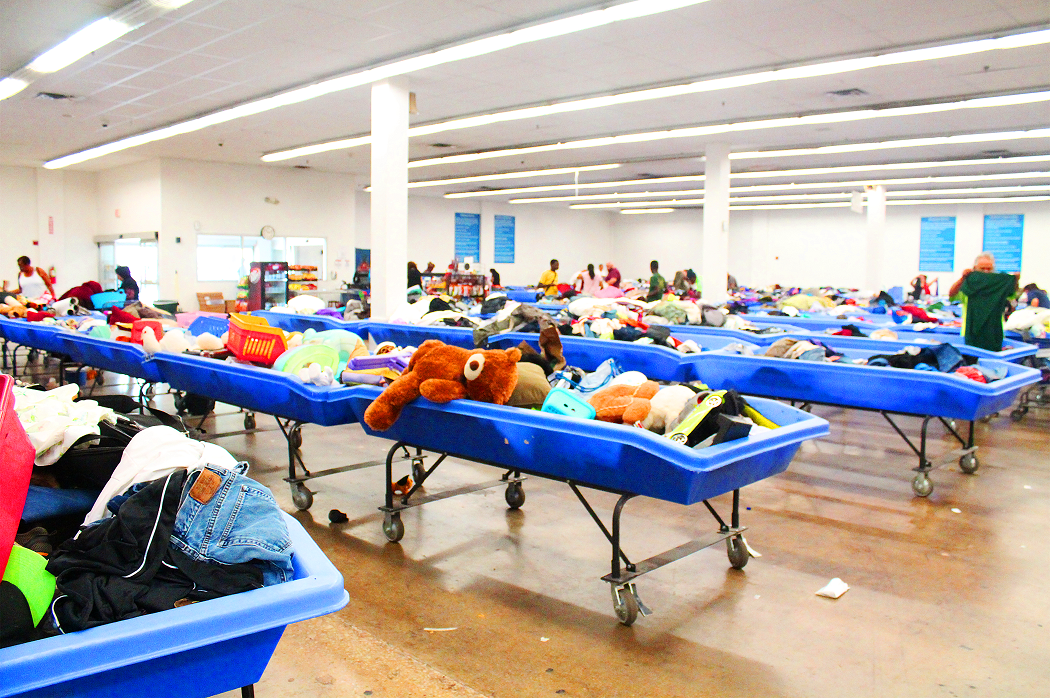
Not too long ago, Rhonda "discovered" the Goodwill Outlet Centers, fondly referred to as "The Bins." As you can see above, stuff is indeed loaded into blue bins on rollers. The bins are the last stop for items donated to Goodwill but did not sell in a regular Goodwill Store. Because Goodwill gets so many donations, I believe that some of the things that end up in the bins never go to a store but rather go directly to the bins. If you looked at the link above, you will note that whatever you find is sold by the pound. Most amazingly to me is that there are three Outlet Centers in Denver that are open 8 to 8 six days a week and 9 to 6 on Sunday - and - a new row of bins is rolled out every 15 to 30 minutes! There are two main sections of bins, one for clothes and the other for miscellaneous stuff, and I do mean miscellaneous!! After the bins are picked over, the next stop for all of the stuff is either a recycling center or a landfill.
The first point about the bins is that it is a very sad commentary on consumerism in our society. While some of the stuff is worthy of being pitched, there is so much stuff that clearly has utility. Indeed, we have seen many things that are brand new with their original labels and price tags. It would take way too long to list all of the various stuff that ends up at the bins, and sadly a lot of useful stuff gets rolled away.
The second point about the bins is that most of the "shoppers" are resellers who are there many hours per week. We have chatted with a few of these denizens of the bins, and they generally have specific things that they are looking for. Most resell on eBay or Poshmark, but some have flea market booths or consign with resale shops. For Rhonda and me, it is pretty much a scavenger hunt! And a good Mennonite one at that since it's $1.49 a pound!! Much of what we get is for family and friends, but we do find some nice resale items, such as Longaberger Baskets and high-end sports equipment. I keep my eye out for the latter because Play It Again Sports and the Boulder Sports Recycler are good places for sales. Here is a great tutorial for how to shop at the bins - and one point that I would add from our perspective, don't try to compete with the "pros" who make a beeline for specific items - the shoe grabbers are the worst!!! We generally wait for the initial madness of the dash to a new set of bins settles down, and then proceed to dig through - heaven knows that there is plenty to dig through! And there can be some interesting findings at the bottom of the bins - I once found a Walmart gift card that had $25 on it!
We have kept for ourselves, kids and grand-kids a variety of very nice shoes, boots, jackets, clothes, tools, kitchenware, and crafting materials, as well as bought some things for gifts and for resale. Examples of sports resale items - Flylow, Volcom, Spyder, Gorsuch, Northface, Columbia, Fossil and Obermeyer jackets, Eddie Bauer clothes, Smith sunglasses and goggles, Pearl Izumi jackets, Burton outerwear and snowboard bags, Merrill and Sorel shoes, Riedell Emerald skates, Orvis fishing gear, and so on. Bottom line is that we are keeping a few worthwhile items from being trashed, and come out a bit ahead with the resales!
Rhonda was recently watching a Netflix series called Glow Up. I caught some bits and pieces, and in one of the episodes, one of the guest judges was drag queen Kim Chi. I thought Sang-Young/Kim was a fascinating, impressive and interesting man/woman. Below are a few examples of Kim Chi's work:
Page views at this humble blog have passed 200,000, so thanks to all who have visited and special thanks to those who have commented. A recent visitor stated that I "must be a musician" and since I have dabbled for decades, My Musical Journey will be the subject of my next post. Muchas gracias, amigos.
There is a lovely small grass pasture adjacent to the Peak to Peak Highway between Nederland and Ward, Colorado. Each summer I have noted multiple rings in the pasture, with the ring being a much darker, more robust-looking green.
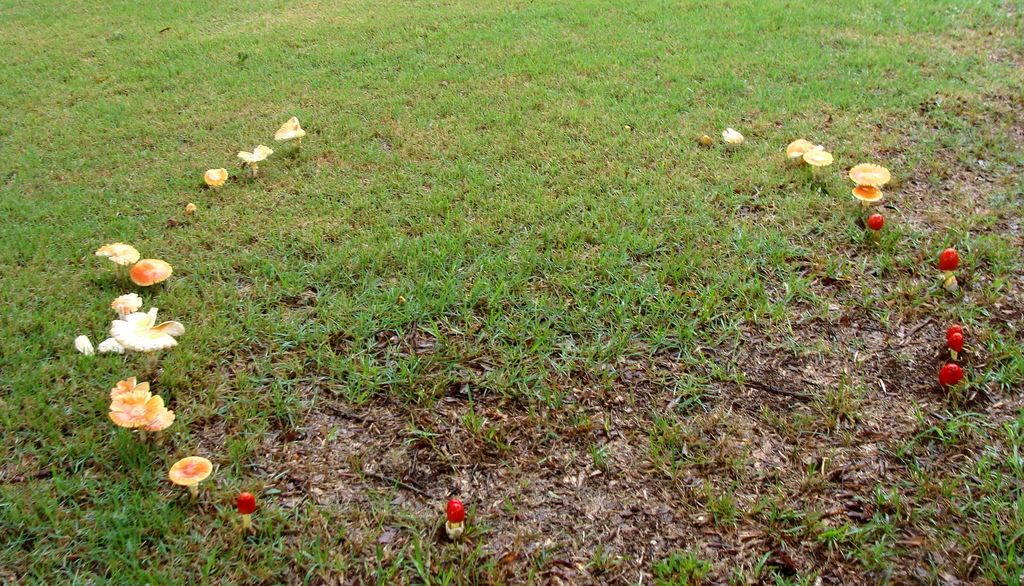
I did a bit of research and found quite a bit of information about "Fairy Rings"of which there are three general types - green ones as shown above, brown rings and ones consisting of rings of mushrooms. Each are basically an every-expanding ring of fungi that expand from a few inches to several feet per year. The elevation of the pasture is around 9000 feet [2745 meters]. A detailed description of fairy rings can be found here and a research article can be found here. Fairy rings seem to be a turf problem, especially for golf courses. Below are a couple of pictures of the mushroom type of fairy rings.
Not related to the rings, but along the Peak to Peak I have seen a variety of wildlife, including an especially beautiful black fox, coyotes, deer, bears, and moose.
One of my many cousins recently commented on the longevity of the Plank/Aschliman clan, and it got me to think about how longevity data are presented. We generally hear about the "average" age of lifespan/death for males and females in the US, which is the mean. However, I was interested to find out the median, the age at which half of the folks are alive and half are dead, and the mode, the age at which most people die. I found such data at this website, some of which are below:
So with regard to lifespans:
Mean life expectancy would be the average age at death,
Median life expectancy would be the age which 50% of people will die prior to reaching, and which 50% of people will live past, and
Mode life expectancy would be the most common age at death.
Here is the frequency of male deaths by age
Thus, from this chart we can see the infant mortality is significant, that the average/mean age at death is 76, the median age is just past 80, and the mode is 86. As would be expected, if you reach a certain age, say 60, these number shift to the right a bit - if you make it to 60, the average/mean becomes 81.5, the median becomes 82.5 and the mode becomes 89. And the numbers for females are several years higher. Of course these shifts to older ages have a finite limit since everyone dies sooner or later!!!
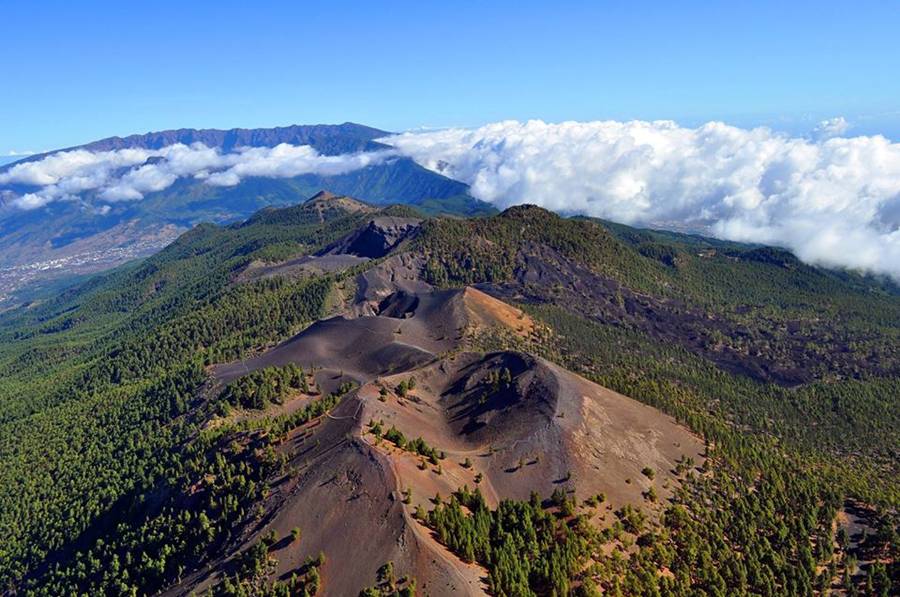
Lots of folks like to envision "the big one" in California and all of the destruction that would ensue, but not too many think about the effect that Cumbre Vieja, or the "old summit" on La Palma in the Canary Islands, might have on the eastern US from the northeast to Florida.
The fear is that the Cumbre Vieja might fail, and if it does so in one complete collapse, the crumbling mountain falling into the ocean would cause a mega tsunami that would quickly spread across the Atlantic Ocean.
Here is a simulation of the tsunami:
So, not too worried about this here in the Rockies!!
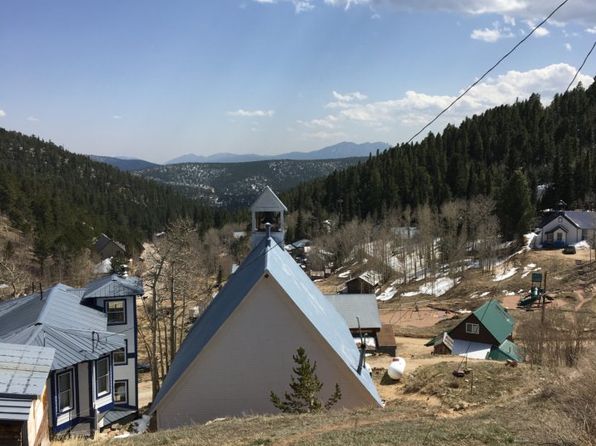
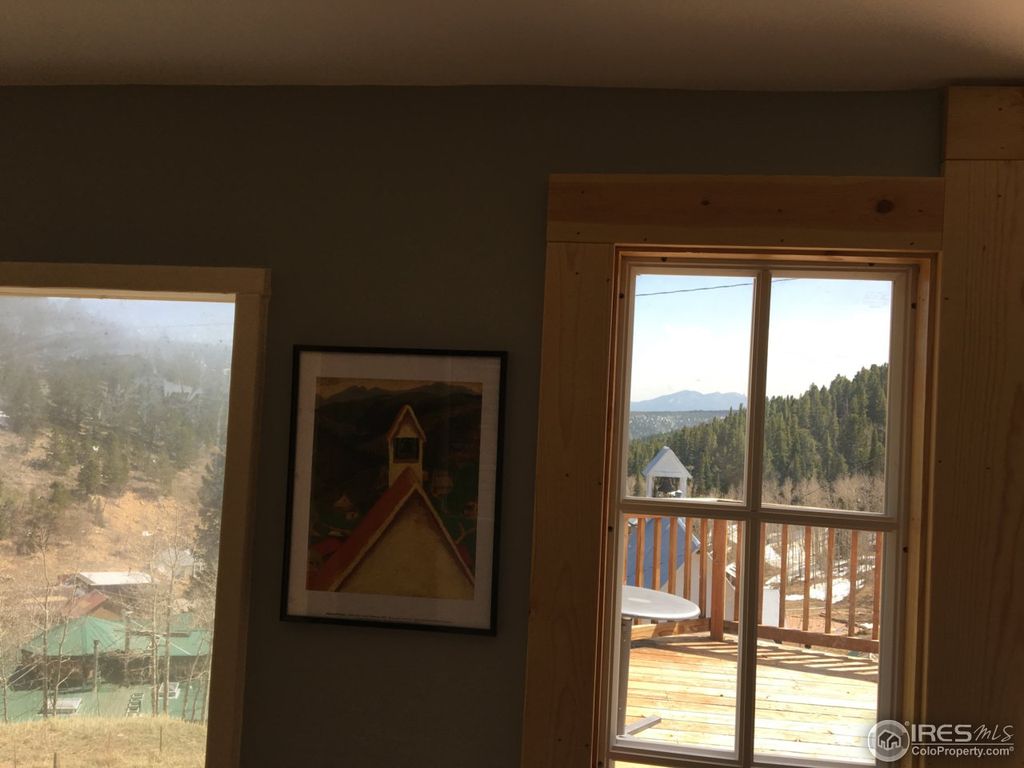
I never knew that there was a nexus between these two. But I discovered the connection while looking at some photos of a home for sale in Ward. Here is the view from the living room:
Here is another photo taken from the living room:
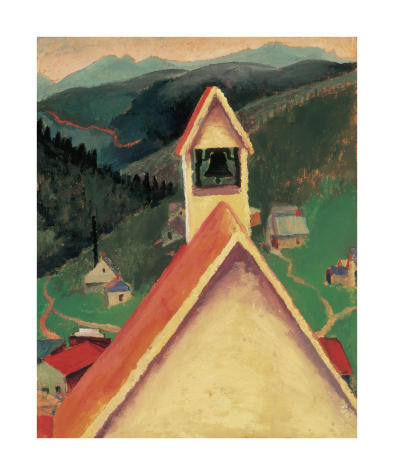
Note the poster on the wall. Here is the original:
The title is simply Church Bell, Ward, Colorado, 1917. And, in checking things out a bit more, I found this article in the Boulder Daily Camera explaining a bit about the marketing of the home for sale. The linked Camera article also has a nice description of how O'Keeffe happened to pass through Ward. The original painting is a 14-by-17-inch oil-on-board and is at the Georgia O'Keeffe Museum in Santa Fe, N.M., but is not currently on display.
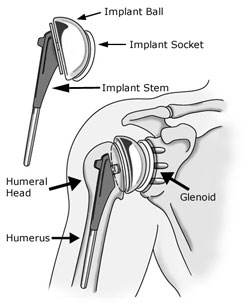
Posting has a been a bit light lately since I have been Rhonda's personal servant for a few weeks. Some of you know that she recently received a new right shoulder, and the rehabilitation takes quite a while - e.g. she cannot drive until mid-December, and physical therapy is still limited motion.
So for those of you who might be interested, I found a video of shoulder replacement surgery - and - if you are at all squeamish about blood and gore, I highly recommend that you refrain from viewing!! 😊 It is quite amazing what orthopedic surgeons can accomplish, and that is probably why they are rewarded quite handsomely, eh Cousin Mark??
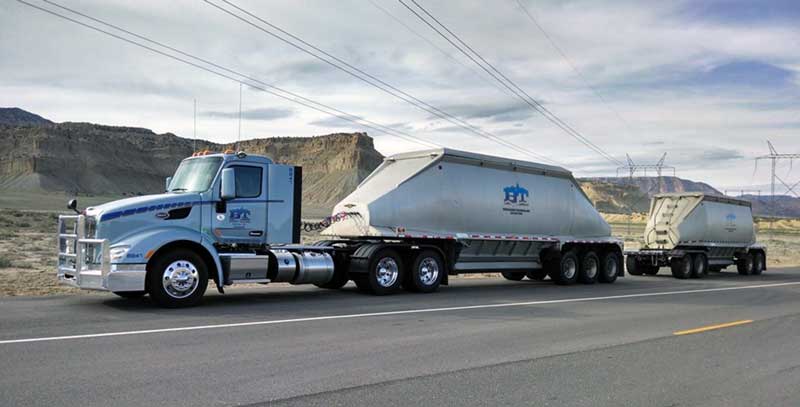
We have made the Denver-LA trek quite a few times, taking I-70 and I-15. Each time that we pass through central Utah, I would note a sudden appearance of these trucks on the Interstate 70:
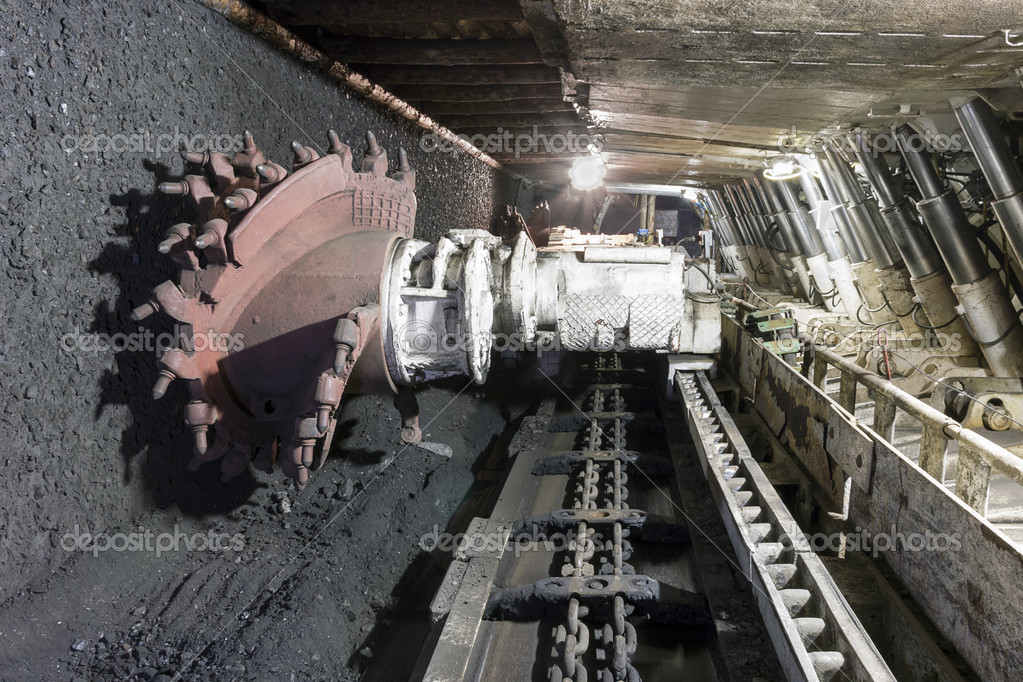
It took me a while to figure out that the BT was for Barney Trucking, and that the trucks were making their appearance around the Convulsion Road interchange east of Salina, UT. Since it wasn't clear what they were trucking, I got on Google Maps to see if there was any evidence of mining in the area. I thought that maybe there would be open pit mining of some sort, but none showed up. However, there was a marker for the Sufco Mine. Turns out that the Sufco is a huge underground coal mine, and the trucks were carrying coal west to power plants. Here is the blurb from the Sufco web site:
The Sufco mine, which derives its name from its former owner,
Southern Utah Fuel Co is one of the longest continuously running and
most productive underground longwall mines in the U.S. It has been in
continuous operation since 1941, initially as a room-and-pillar coal
mine and since 1985 as a high-performance longwall operation. The Sufco mining complex is located in Sevier County, UT
approximately 30 miles north east of Salina, UT and 125 miles south of
Salt Lake City, UT. It is located in the Blackhawk Formation in the
Wasatch Plateau coalfield in which eight coal beds have been identified
that contain coal seams more than seven feet thick.
Sufco has longwall and continuous miner reserves in the Upper
Hiawatha and Lower Hiawatha seams in which it produces high-BTU,
low-sulfur, compliance thermal coal.
Barracuda - the fish, the car, the song, the ride, the gun, the hockey team, the airplane, the bicycles, the swim wear, and I am sure there are more......
I cannot find a picture of the Barracuda ride, but it was a very popular attraction at the Elkhart County Fair back in the day - rode around fast in wavy circles with the music blasting.
I would wager that many of you have never heard of Slab City. I was also unaware until very recently - our niece visited there and posted some pictures on Facebook. Interesting.....here are some tidbits of information taken from here and here [nice pictures]:
Slab City, or The Slabs, is a free campsite and alternative living
community located near an active bombing range in the desert city of
Niland, California. Previously an old WWII base, Marine Barracks Camp
Dunlap, the campsite earns its name for the concrete slabs that remained
long after the military base had been bulldozed and abandoned.
There are no rules or fees at the Slabs. The community enacts no laws,
and has no running water, power lines, sewage service or trash pickup,
giving the place a Mad Max post-apocalyptic look and feel. During the
winter months, as many as several thousand campers – mostly elderly
retirees – flock there for the warm desert weather and the lack of fees.
These seasonal residents, known as "snowbirds," live in a variety of
housing structures. Though most come to the area in their RVs, many also
squat in abandoned structures such as old inoperative buses, driftwood
shacks, abandoned water tanks, or any place that provides a little
protection from the elements. A small population lives there year-round,
braving the harsh summer months when temperatures can reach above 120
degrees Fahrenheit.
Slab City is adjacent to the Salton Sea which is just a strange thing too- communities built
and abandoned based on the behavior of the rivers feeding it. And Slab is an
abandoned Naval base (technically toxic land) so people squat there for free.
The winter season can bring as many as 2-3k and only about 200 stay all summer.
Everything from ex cons, extremely poor retirees, dirty hippies, misfits. At
the Saturday night social event, I had a fellow to my right, a rugged young man
studying alternative living cultures in the US for his PhD in anthro-biology
or something like that- and to my left, an older white woman who had
been "livin' in cages" (prison) the past 7 years until she found
heaven at Slab.
I
spent one night but jumped ship about 6 hours into the desert heat of day 2. I
left my friend who wanted to tough it out. I just couldn't bring myself to
actually crap in the hole out back. And then make food. And then lay around in
the filth, which was the only agenda for the day. I found a cool motel room
nearby and went back for a visit the next morning.
There
is no running water, but they've got their community system- one guy supplies
water bottles and fills water tanks, (meanwhile "town" is literally 2
miles outside the borders of Slab but some folks just actually never go out
into reality) another guy sells solar panels, (so even little shitty shacks
made of nothing have solar panels on them), they have a library, two music
venues, an Internet cafe, they hold weekly events and "feeds".... But
let me paint it properly- there is nothing "quaint" about it.
They live in their own trash- I'm not trying to be demeaning- just giving
you the raw truth, it's not cute. Its poverty, filth, unsanitary conditions and
lawlessness like you've only seen in the 3rd world. And then there's art,
everywhere....
Fascinating.
There
is a fenced off canal they say they bath in sometimes. I noticed police
patrolling quite regularly and they said its because the canal is a through way for
"illegals" coming up from Mexicali. Well... That AND in less than 24
hrs I saw 2 people get arrested and hauled off, (and thankfully the night I
slept at the motel), someone set someone's camp on fire- a woman said it was a
huge blaze with propane explosions and all. Apparently the community was fed up
with him because he likes to shoot at cars that drive by his camp too fast and last
week he unwittingly shot the leg of a woman who was hanging off the back
of the truck. He aimed for tail lights and didn't see her. Anyway- he was taken
to jail the night before we arrived and the community purged him while he was
gone. Can't help but wonder what ensued when he came back to find his camp in
ashes.
Had
I actually KNOWN the type of lawlessness and unsanitary conditions, I probably
would not have gone. So I guess some things are better left a mystery. Reminded
me that there are alternate realities all around us.