Showing posts with label University of Colorado. Show all posts

Sunday, April 22, 2018

THE ENT CENTER AT CU-COLORADO SPRINGS

A whole lot has changed at the CU-Colorado Springs campus since I arrived in 1982, but perhaps the most dramatic addition is the new Ent Center for the Arts.  There was a nice write-up about the Center in today's Denver Post, and it is pasted below.  I am looking forward to having a tour of the place and perhaps attending an event.

The Ent Center was a collaborative project between New York’s H3 Hardy Collaborative Architecture and Denve’s Semple Brown Design. (Ray Mark Rinaldi, Special to The Denver Post)
The new Ent Center for the Arts in Colorado Springs arrives with all the optimism that forward-thinking architecture can deliver.

The building — monumental at 92,000 square feet and pricey at $70 million — is an investment in things real and symbolic. It will give the University of Colorado practical, state-of-the art classrooms for students endeavoring to be tomorrow’s creative class, and it will boost the Springs location to the top of the facilities hill in the state university system. No other outpost has a venue quite like it, not even the prestigious Boulder campus.

The building will also serve as a cultural hub for the region at large. The four theaters and art gallery will act as a connector between the college and the community, a place for the public to see plays, concerts and exhibits, and a resource for local cultural groups who will rent out its spaces to present their own events.
The UCCS Presents series hosts international-class performers, like violinist Sarah Chang, jazz star Branford Marsalis and the Alvin Ailey II dance company. (Provided by Semple Brown Design)
TheatreWorks — the respected, resident professional stage company — is already doing shows there, and the university has kicked off its UCCS Presents series, hosting international-class performers like violinist Sarah Chang, jazz star Branford Marsalis and the Alvin Ailey II dance company.

But, thanks to its design, the Ent Center is also a beacon signaling the importance of culture. Metallic and curvy, it sits on top of rising terrain northwest of the campus close to Highway 25. The building shimmers and waves, bringing attention to itself and the programming inside, as if to say “Art is important” and, perhaps more crucially, “Art is fun, too.”

The design is a collaboration between firms near and far. H3 Hardy Collaborative Architecture took the lead. The New York-based firm has done work on cultural projects across the country and also advised the city of Denver on the possible redo of the Denver Performing Arts Complex downtown.
The local partner, and a crucial player in the way the building turned out, is Semple Brown Design, whose efforts were led by Bryan Schmidt and Dru Schwyhart. The firm is one of Denver’s best, responsible for such landmarks as the Ellie Caulkins Opera House, RedLine arts center and the Colorado Ballet studios.

The Ent’s defining feature comes from a series of undulating bands of steel that layer together to form its facade. They pulse unpredictably and keep the static building in motion, giving it, in a sense, a perpetual, in-and-out breath.

The steel bands are showy but they’re not all show. The irregular curves are employed functionally, serving as floors for small, open-air balconies above them and overhangs for protected sitting areas beneath. One cantilevers far out over the building’s main entrance to create a canopy welcoming visitors.

They also work as sun shade protection and are part of a long lineup of gestures that earned the structure LEED Gold certification from the U.S. Green Building Council.
The building’s lobby doubles as a study lounge for students. (Provided by Semple Brown Design)
The Ent’s other notable highlight is its lobby, which serves multiple purposes. Tall, glassy and art-friendly, it is a sunny student lounge by day, and an elegant gathering place for audiences attending events in the evening.

Cleverly, the lobby narrows and morphs into a corridor leading to all of the center’s major venues. It links visitors to the main theaters and, eventually, to the art gallery — but the transition is subtle, it never feels like a boring passageway.

Part of that effect comes from the fact that the art gallery itself spills into the main area. The corridor is rigged to hold art that is hung on walls and suspended from the ceiling. Plenty of performing arts centers use their lobbies as galleries, but they are most often an after-thought. Here, it is difficult to tell where the theaters stop and the gallery begins.

This works to pull together a diverse lineup of rooms: a 750-seat, general purpose theater with an orchestra pit and generous fly space; an intimate 225-seat recital hall; a 250-seat, flexible space for plays; and, finally, the art gallery.

All of the facilities provide a lift for the university’s students and its public offerings. The gallery in particular — at 2,500 square feet and with precision climate control and a “suspension strong point grid,” which allows curators to take advantage of the floors, walls and ceilings — will permit the sort of ambitious exhibition program the area has not seen.

Colorado Springs has a long tradition of support for both the visual and performing arts, but it’s never quite built the reputation of other cities and towns along the Front Range. No doubt, that has more to do with a shortage of suitable facilities than with a lack of artists or the people who back them.

The Ent Center — named for the Ent Credit Union, the local institution that provided financial support — creates the kind of infrastructure that allows for big things to happen. It’s a bold move, with seismic implications for the region’s cultural geography. Colorado Springs may not currently be a major cultural destination in the state, but the center gives it a bright future.

That is the kind of change determined universities can spark for their home cities, and that art can make inevitable if artists seize the opportunities and challenge themselves and the community.
But it is also the revolution that architects can start when they understand their job is to create opportunities, and lead clients to create audacious buildings that act out, sing loud and show off.
The new $70 million Ent Center shifts the region’s cultural scene toward Colorado Springs. (Provided by Semple Brown Design)

Sunday, January 03, 2016

CU BASKETBALL RIGHT ON SCHEDULE

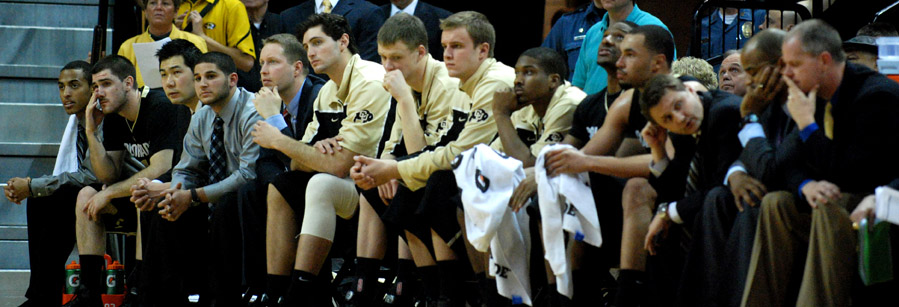
 https://kbiasportsextra.files.wordpress.com/2011/02/cu-bench.jpg?w=899

I should have published this a few days ago because I believed that this was coming.  As is typical for big Division I schools, the early season basketball schedule is loaded with patsies who are simply happy to get a good payday and perhaps an upset of a supposedly superior team.  The CU men won 11 and lost 2 in the pre-PAC12 Conference play, but the 11 wins were generally versus mediocre teams, while the 2 losses were to decent teams.  So while Coach Boyle's proclaimed the he was 'bullish on the Buffs' going in to Conference play, I would have bet dollars to donuts that the basketball team would follow the inauspicious footsteps of the football team and not be able to win in their Conference opener:

California 79 -  University of Colorado  65. 

The women did not fare any better: 

Washington 76 - Colorado 74.

The men play tonight at Stanford, and if anyone wants to be even up on Colorado, I will take that bet.

Friday, February 20, 2015

CU ATHLETICS ARMS RACE

Yesterday, the University of Colorado Regents met in Boulder, and one of the sessions was on Intercollegiate Athletics.  The CU-Boulder AD gave a typical shock-and-awe, look how great I am doing presentation, which was followed by the significantly more modest presentation by the CU-Colorado Springs AD. 

Perhaps the most insightful, and troubling, observation was made by Chancellor Pam Shockley from the CU-Colorado Springs campus.  In her comments to the Regents, she said that she fears an "arms race" in Division II athletics that is similar in nature but on a smaller scale than the "arms race" in Division I athletics.  AD Rick George's presentation could be labeled Exhibit A for the demonstration of the misguided and generally uselessness of "pursuing championships" by throwing money at athletic facilities and the elusive "student-athlete."  [Just to clarify, there really are some athletes who  are also accomplished students, but they tend to be the exception rather than the norm among the participants in Division I football and basketball]. 

After presenting the data demonstrating how well the student athletes are doing academically, and how well they are attended to regarding their studies, he launched into his breathless presentation of the $143,000,000 expansion and renovation of athletic facilities, shown in this sketch:

http://www.coloradanmagazine.org/wp-content/uploads/2014/07/athletics_complex_expansion_2014.jpg 

Not surprisingly, the bulk of the project is for the benefit of football, while the other sports will enjoy some of the trickle-down from the new indoor practice facility, shown on the left, and the new training and sports medicine facilities. More details can be found here.  Interestingly, I got to tour the 'old' football facilities a couple of years ago and considered them palatial when compared to some of the other facilities on campus - see below.

So - what's the point?  It's the same old canard that CU cannot compete effectively in the PAC 12 because the limited and outdated facilities cause highly talented athletes to go elsewhere.  Tell that to cross country coach Mark Wetmore.  Wetmore's office is in a backwater space in the dingy and dark Balch Fieldhouse.  It's not the facilities that attract some of the top runners in the country to CU, it's the outstanding coaching and the tradition of excellence that brings them in.  Wetmore's teams have won multiple national and PAC-12 championships, and hundreds of other team and individual honors.  Admittedly, cross country is not a facilities-intensive sport, but the point is that facilities don't build champions - effective recruitment, training and coaching build champions.


http://extras.mnginteractive.com/live/media/site36/2013/0810/20130810__20130811_C1_SP11CUPROJECTPART1~p4.jpg

Balch Fieldhouse - Home of National Champion Runners & Coaches - Built in 1937

But - who is it that really cares about championships?  Regents, Presidents, Athletic Directors and all of the attendant athletics staff, and Chancellors and fund-raisers who woo athletics-crazed donors.  Who doesn't care?  Most professors and many students. 

Why?  At the beginning of all of my classes, I make it clear that it is possible, although not probable, that every student in the class can earn an A.  Exceptional performance is rewarded accordingly.  (I generally don't point out to them that they could all possibly earn F's :-).  In academics, it is not student versus student, with an equal number of winners and losers - it is individual students mastering the subject matter.  Intercollegiate athletics are nearly diametric to this fundamental mission of the university.  Regents, Presidents, etc., seem not to understand that athletic competition is a zero sum game - for every PAC 12 team that wins, another PAC 12 team loses.  For every 15-2 team, there is likely to be a 2-15 team.  And there is only one champion among the 12, and there will be only one football champion among the 120 Division I FBS teams, and 1 basketball champion among the 351 Division I basketball teams.

Another thing that is totally out of wack in Division I football and basketball is that it is now considered career advancement by moving from the ranks of professional sports to university sports. Of course the driving factor now is the money.  I have previously written about Rick [aka Dick IMHO] George's sweet deal [Money for Nothin'] to move from the Texas Rangers to CU, and most recently, CU hired an San Fancisco 49ers coach as an assistant football coach for $500,000 per year - highest in the history of CU.

I think that it would be great if the CU Regents, administrators and other powers-that-be torched football and [sadly as a Hoosier] basketball.  Can you imagine how great the remaining teams would be if the resources were re-directed their way??!!  The University of Alabama-Birmingham is the latest addition to the long list of schools that have eliminated Division I football.  Universities need to get out of the business of being minor-league development tools for professional teams.  Of course I know that there is not a snowballs chance that this will come to pass, but one can dream......